last updated 29 April 2026
Prostate cancer is the 2nd most common nonskin malignancy affecting men in the US and is the fifth leading cause of cancer death. The incidence of prostate cancer increases dramatically with age.
Anatomy:
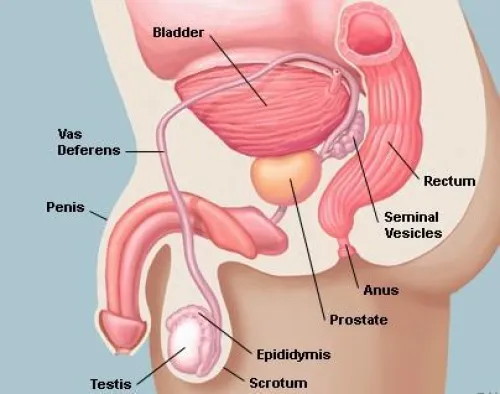
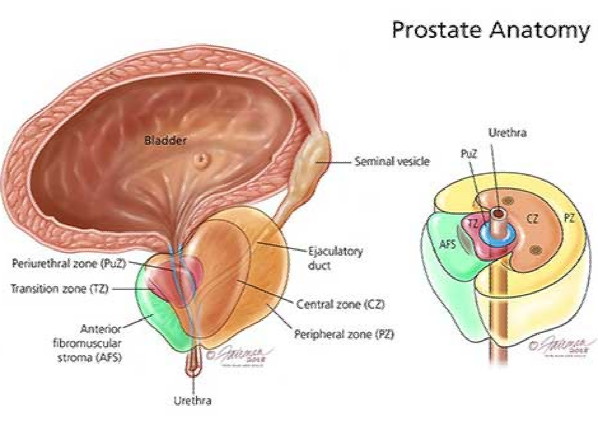
The prostate gland is about the size of a walnut. It's located just below the bladder, and it surrounds the urethra. This is a tube that carries urine and semen out of the body. The prostate is partly muscular and partly glandular. It has tubes (ducts) that open into the prostatic part of the urethra. It's made up of 3 lobes: a middle lobe, left lobe, and right lobe.
The prostate produces and contains fluid that forms part of semen, the substance emitted during ejaculation as part of the male sexual response.
Diagnosis:
-
Prostate-Specific Antigen (PSA) blood test. It should be less than 6.4 ng/mL (see below why PSA is not recommended for older men.)
- Enlarged prostrate detected in a Digital Rectal Exam (DRE).
or suspicious findings on an MRI.
- Blood in the urine, which might make the urine look pink, red or cola-colored.
- Blood in the semen.
- Needing to urinate more often.
- Trouble getting started when trying to urinate.
- Waking up to urinate more often at night.
Who's too old to screen? Prostate cancer in elderly men | Canadian Urological Assn. in PubMed at NIH, 2009 says,
"We did biopsies of 1,446 men between the ages of 75 and 85.
The incidence of prostate cancer increases dramatically with age. Many health authorities advocate the cessation of routine prostate cancer testing in men older than 75 because of the belief that most patients will have a clinically insignificant cancer and will not benefit from therapy.
When I read this article and others recommending PSA testing be stoped after age 60 or 70, I did NOT agree with the conclusion, just by their data.
My case would also argue against their logic. I'm 81 and still ski advanced slopes. I was still running half marathons at 70 and am generally fit.
I was tested and had a PSA of 69. a biopsy had a Gleason score of 9 out of 10 (Group 5 High).
I have a friend in his 90's. His PSA was 40 with a Gleason score of 7 (Group 2), so was slow growing, so he figures something else will get him before prostrate and is leaving it alone.
My PSA must have been rising for some time and should have been tested after the age of 60 to see a trend. (One side recommended against using trends, but I think this means trends between PSA of 4 and 10. When it is over 10 I think it should continue to be tested.
PSA Screening
The American Urological Association recommends prostate cancer screenings starting at ages 45 to 50 and then advises men ages 50 to 69 to be tested every two to four years.
Benign prostatic hyperplasia is the increase in size of the prostate, without the presence of malignancy. It is much more common with advancing age.
Signs and symptoms of advanced prostate cancer can include:
- Accidental leaking of urine.
- Back pain.
- Bone pain.
- Difficulty getting an erection, called erectile dysfunction.
- Feeling very tired.
- Losing weight without trying.
- Weakness in the arms or legs.
Treatments
Links
Prostrate Cancer | Mayo Clinic
Symptoms&Causes |
Diagnosis & Treatment | Stages | Survival Rates | Doctors & departments |
Care at Mayo Clinic
Tom's Summary
>
Prostate Cancer Education | UCSF
Other treatments (some still in the trial stage)
- Laser therapy:
Tom did a search and commented. "Based on some quick searches, laser therapy is still an experimental technique and mainly used for low to intermediate risk prostate cancer (rather than high risk prostate cancer like yours). It has become more popular as cancer screening has started to identify more patients with low-intermediate risk, but it seems like a few studies found no benefit (and potentially worse mortality) for LT when compared to active surveillance/watchful waiting.
- External beam radiotherapy for prostate cancer | Cancer Research UK
External beam radiotherapy uses high energy x-rays to kill prostate cancer cells. It uses a machine outside the body to direct radiation beams at the cancer. You might have it with hormone therapy.
Side effects of prostate cancer radiotherapy | Cancer Research UK
Books:
Guide to Prostate Diseases, Harvard, 2026-27
Miscelaneous:
PSA Screening
Glossary
 Health