 Health
Cause of Death
Cancer
Prostrate
GUNS Trial
Health
Cause of Death
Cancer
Prostrate
GUNS Trial
| Don's Home
Health
Cause of Death
Cancer
Prostrate
GUNS Trial
|
GUNS (Genomic Umbrella Neoadjuvant Study )
This study
GUNS (Genomic Umbrella Neoadjuvant Study )
GUNS is part of Vancouver Prostate Centre (VPC)s My Precision Oncology Program (MyPOP)
It targets men with high-risk localized prostate cancer.
It does genomic sequencing of tissue from the tumor (sometimes a blood sample)
to identify specific genomic alterations and match them with one of 6 therapies which are designed to,
Improve pathologic response pathologic response
< 5 mm minimal residual disease [MRD]). reducing the the need for follow-up radiation after surgery. and
They
or
The Genomic-biomarker-selected Umbrella Neoadjuvant Study (GUNS) is a multicenter, adaptive phase II clinical trial led by Dr. Martin Gleave at the Vancouver Prostate Centre, designed to improve outcomes for patients with high-risk localized prostate cancer (HRLPC).
The trial utilizes a precision oncology approach by sequencing patient tumor biopsies or blood to match specific genomic alterations with targeted neoadjuvant therapies (cancer treatments administered before the primary treatment,) administered prior to radical prostatectomy.
Patients receive an initial 8-week course of androgen deprivation therapy (ADT) plus apalutamide while their tumor DNA and RNA are sequenced.
Tempus is a lab which does genetic analysis from a blood sample, which they can use.
Patients are assigned to one of 6 (as of 2026) trial protocols.
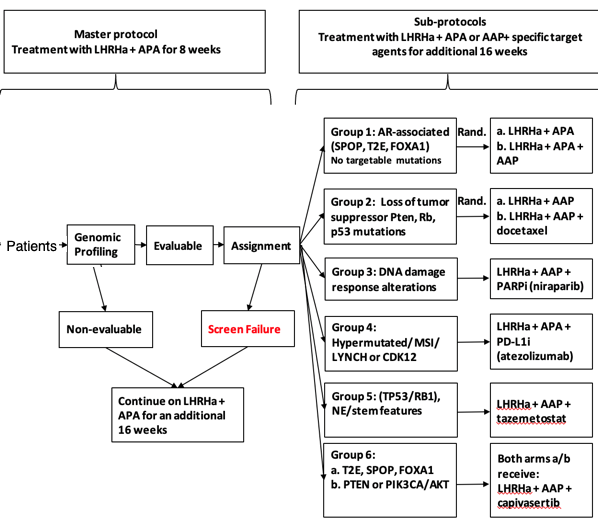
GUNS (Genomic biomarker-selected umbrella neoadjuvant study for high risk localized prostate cancer) Trail | Vancouver Prostrate Center 2026
Results of sub-protocol 1 of the Genomic Umbrella Neoadjuvant Study (GUNS) trial - 2025 ASCO (American Society of Clinical Oncology) Symposium
AI response from Google Search:
For patients with high-risk localized prostate cancer.
Trial Design: The study utilizes a precision oncology approach where patients receive an initial 8-week course of androgen deprivation therapy (ADT) plus apalutamide while their tumor DNA and RNA are sequenced.
Biomarker-Driven Allocation: Based on genomic profiling, patients are assigned to specific sub-protocols:
AR-associated alterations (e.g., ETS fusions, FOXA1, SPOP): Randomized to receive either the doublet therapy or a triplet adding abiraterone.
Aggressive tumor suppressor loss (e.g., RB1, PTEN, TP53): Assigned to receive docetaxel chemotherapy.
DNA repair deficiencies (e.g., BRCA): Treated with the PARP inhibitor niraparib.
Immunogenic alterations (e.g., MMR deficiency): Treated with the PD-L1 inhibitor atezolizumab.
The earliest reference I could find was in the 1919 SUO (Society of Urologic Oncologuy) Annual meeting, so it's been around at least 6 years.
My Precision Oncology Program (MyPOP)| Vancouver Prostate Center
The Vancouver Prostate Centre's MyPOP (My Precision Oncology Program) is a recently launched clinical research program which strives to better deliver personalized therapeutics to patients with advanced or treatment-resistant cancer of the prostate, kidney or bladder.
The program is currently available only to patients of the VPC or BCC who meet specific clinical trial criteria.
The program's objectives are to:
LRH - Luteinizing hormone-releasing hormone (also called LHRH analogs or GnRH (Gonadatropin Releasing Hormone) agonists) are drugs that lower the amount of testosterone made by the testicles.
I believe you mean the GUNS trial — Genomic Umbrella Neoadjuvant Study (NCT04812366) for high-risk, localized prostate cancer.
The most recent results, presented at the 2026 ASCO Genitourinary Cancers Symposium, are quite interesting:
GUNS is testing whether treatment can be matched to the genetic characteristics of a man's prostate cancer before surgery. Patients receive hormone therapy plus apalutamide, followed by additional treatment based on tumor genetics.
In one group of 48 men whose cancers had aggressive TP53, PTEN or AKT alterations, patients were randomized to hormone/AR-pathway therapy alone versus the same treatment plus six cycles of docetaxel chemotherapy. The addition of docetaxel produced a substantially better pathological response: 26% achieved minimal residual disease (<5 mm) versus 0% with the hormone/AR-pathway treatment alone. This difference was statistically significant (p=0.0463).
The researchers therefore concluded that the combination of AR-pathway therapy + docetaxel is promising for this particular genetically aggressive group and warrants further study.
Earlier GUNS results from another genetic subgroup were also encouraging: adding additional AR-pathway treatment produced minimal residual disease in 43% versus 13% with the simpler treatment, although there were no complete pathological responses in that group.
An important caveat These are early, pathological-response results, not yet proof that GUNS improves long-term survival or prevents recurrence. The trial is still ongoing, and the investigators are expanding the promising treatment arms.
If you're asking because you or someone you know is considering GUNS treatment, I can also explain what these results mean in practical terms — including PSA response, Gleason score, surgery findings, recurrence risk, and whether the results suggest GUNS is better than standard treatment today.
Patient Information at My Precision Oncology Program (MyPOP) at My Precision Oncology Program (MyPOP) | Vancouver Prostrate Center
GUNS Trial Examines Biomarker‑Selected Neoadjuvant Approaches in High‑Risk Prostate Cancer