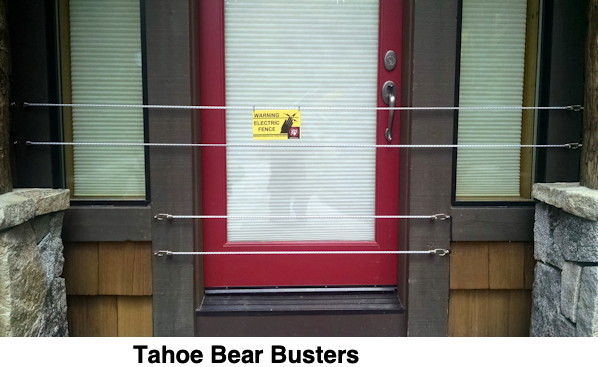
last updated 5 Dec 2025
See Contacts below:
After our
cabin break-in at Tahoe I found several bear pages on donsnotes that I'd created over the last 50 years.
A note to neighbors in New Jersey after a bear went thru our neighborhood at the end of the block with no damage other than a bird feeder.
Another page for my Sierra Club course "Introduction to backpacking".
Some are in the links above and some here.
Bear Break-in Damage to Cabin in Lake Tahoe, CA
Bear League - Lake Tahoe
The Bear League has around 1,800 members and 278 trained volunteers who respond to bear calls. They offer residents and tourists advice on how to keep bears from breaking in, and they’ll shoo away bears from homes upon request.
Read more at: https://www.sacbee.com/news/environment/article204907769.html#storylink=cpy
Lock deadbolts at night
If a bear continues to be a nuisance you can get a depredation permit.
Bear break-in damage"
See Black Bear Depredation Policy in California
Bear Deterrents:
Designated a "no harm no foul,"techniques to remove the bear may include, but are not limited to the use of sound makers, pepper spray, rubber slug shot shells or sling shot projectiles to drive the bear away or haze the bear out of the area.
Black bears are usually afraid of people (But don't rely on this. See below where a bear followed a man into his house.).
So if you use a deterrent which requires you to administer it. It should work from 100 feet away. No squirt guns with ammonia.
Bears were repelled by chemicals only 2.6% of the time, but spent significantly less time spent at the test sites indicating repellency.
__________________________________________
Homewood Bears:
Tahoe bears are breaking into homes with people inside | Sac Bee May, 2022
The Lake Tahoe region along the California-Nevada border has long drawn bears from the Sierra wilderness to the bounty of calorie-rich meals found in the trash and unattended food brought by tourists seeking high mountain vistas and pristine blue waters. In the past several years, though, wildlife biologists in both states say they've been noticing a troubling trend: A growing number of bears have transitioned from dumpster divers to expert burglars.
In the past several years, though, wildlife biologists in both states say they've been noticing a troubling trend: A growing number of bears have transitioned from dumpster divers to expert burglars.
In November 2021, Bob Chaplin who lives on San Souci, "was jolted out of bed at 2 a.m. by the sound of a motion-activated alarm he'd set on his kitchen counter. Bears were in his house. Three cubs had pushed in through a window. Their mother's head was poking through, close enough that Chaplin could see a plastic yellow tag dangling from her ear.
...
I screamed like hell, Chaplin said. The bears crawled back outside."
"By the time winter rolled around and the bears started their hibernation, at least 14 homes in Homewood had been ransacked. Bears had done thousands of dollars in damage."
Links:
West Shore Bears
Bear break-in video, Homewood JN 2020
since 2014, at least nine people have been charged at, swiped or mauled by bears in and around homes and businesses on California’s side of Lake Tahoe. Most just get scratches.
In one case, hearing noise in his kitchen at night, a man came downstairs and was confronted by a bear that had broken in,” The bear stood on hind legs and swiped the victim across the head. Victim retreated but re-entered to try and make the bear leave. Bear swiped his stomach and knocked him down before leaving the cabin. 32 staples.”
Biologists say trapping and moving habitual bear burglars isn’t usually an option. Biologists in Nevada and California have tried relocating troublesome bears in the past, but the animals either eventually wander back or they just become some other community’s problem.
_______________________________________
TAHOE VISTA Again and again, the bear climbed into the Tahoe Vista resident’s pickup and his neighbors’ cars. It broke through a dead-bolted door to get into a neighbor’s home. It acted aggressively when they tried to chase it away, he said. In November, he’d had enough. He got a permit to have the bear killed. Placer County’s trapper parked a cage trap on the man’s lot. In less than 24 hours, the trapper hauled the bear away for good. But that was plenty of time for Tahoe’s vocal and well-organized community of bear activists to spot the trap and share the homeowner’s personal information. Dozens of harassing emails, calls and texts came in.
One local official estimated that bears recently damaged more than 75 homes in a single west shore Tahoe neighborhood. At least one of the homes suffered close to $100,000 in damage. Meanwhile, numerous homeowners have reported coming face to face with bears inside their homes. Newly released state records show some have even been mauled, though none fatally.
Read more at: https://www.sacbee.com/news/california/article238546758.html#storylink=cpy
Black bears, which can range in color from inky black to dirty blonde, are not endangered in California and Nevada, and their numbers are growing in both states. Biologists say Tahoe’s bears, estimated at between 300 and 500 animals, are some of the most densely populated in North America, drawn to the massive amounts of human food and garbage brought to the region by the more than 3 million tourists who visit each year.
Bear Myths and Misconceptions
Posted on NextDoor by Julie Mason, Kings Beach, CA
From Myths and Misconceptions at North American Bear Center ELy MN
The main mission at the North American Bear Center is to educate! This post will do just that as we dispel some common misconceptions and myths about black bears.
Myth 1.) Mother black bears are likely to attack humans in defense of cubs.
The truth: this is a highly unlikely behavior from a mother black bear. Mother black bears rarely attack humans, but they do frequently exhibit bluff charge and blustery behavior in defense of their cubs. It is often interpreted as aggression towards humans, but is really a reflection of their own anxiety and fear. There has only been a handful of recorded attacks on humans from a mother black bear defending cubs. Brown bears on the other hand (which dont exist in the Tahoe/Truckee area) will attack humans in defense of cubs, which is mostly likely where this myth comes from. Ely bears researchers have taken screaming cubs from mothers in their dens (only for a brief time to record scientific data) without the mothers attacking. They would slap the ground and act ferocious, but would refuse to make contact with the researchers.
Myth 2.) Mother bears will reject cubs with human scent.
The truth: this is completely untrue with bears as it is with other mammals and birds. Human scent does not cause the parents to reject caring for their offspring. Most people probably hear this from their parents (or other adult) at a young age, but the fact is that there isn't any evidence to support this. Although you should never approach and handle a baby wild animal (unless conducting approved research and trained to do so), your human scent will not cause the parents to abandon its young. Wildlife rehabilitators have raised young animals and released them to their parents (or other adults with offspring) with no issues due to human scent.
Myth 3.) Black bears will attack if they sense fear.
The truth: no they won’t. Black bear attacks are very rare in general, but fear in humans does not make bears more likely to attack. In fact, most people probably have a primal feeling of fear if they have ever encountered a bear when not expecting it. It is a large and powerful animal that is often portrayed as aggressive and mean; why wouldn't you be fearful in an unexpected encounter? In 1984, Ely bear researchers inadvertently tested whether or not fear provokes an attack from black bears. A researcher tripped and fell flat on his back while trying to move away from a bluff-charging mother black bear. The mother stood over him. He lay petrified, no doubt reeking of fear. His heart raced. After a few long moments eyeball to eyeball, the mother turned and walked back to her cubs. She never touched him.
Hyperphagia - [a feeling of extreme, insatiable hunger] typically runs from August through November. During this period, bears dramatically expand their search radius, often pushing deeper into residential areas. Once a bear finds an easy reward, it tends to return and becomes progressively bolder, according to wildlife officials. In the Tahoe Basin.
In June 2025 wildlife official's reported 170 bear-related property incidents since May 1, 2025, despite no significant increase in overall conflict levels compared to previous years.
This November a bear at South Tahoe followed a man back into his house.
the bear swiped at him and scratched his hand," said Ashley Zeme, a spokesperson for the Nevada Department of Wildlife. "Then the bear followed him into the home."
Moments later, the confused bear scratched the homeowner’s wife before bolting back outside after the couple’s granddaughter opened doors and windows to create exits. Both residents were treated and released from the hospital with minor injuries.
In 2023, in the small town of Downieville, California, in Sierra County, 71-year-old Patrice "Patty" Miller lived alone in a rented yellow turn-of-the-century cottage a block from the county courthouse.
She had been setting out cat food on her front porch, and there was garbage in and outside the house.
A bear or bears had made repeated attempts to enter her home. "She had bars installed on her kitchen window.
On November 8, 2023, a friend reported that Miller hadn’t been seen for a few days. A sheriff’s deputy went to the house, peered through the half-glass front door, saw a trail of blood smeared across the living room floor, drew his gun, and broke in the door. Inside, he found piles of bear scat in the living room and Miller’s body in the kitchen.
It was believed that Miller might have died of other causes before the bear broke in and fed on her.
They later trapped a bear and DNA tests indicated it matched those from Miller's body and killed it.
The Battle Over Black Bears | alta-online.com
A common misconception is that conflict bears—those that have entered homes and garages or approached, charged, or injured humans—can be relocated to some wild place where they will return to their native foods. In reality, relocation has, for the most part, been a dismal failure.
Both California and Nevada maintain an option of sending cubs to rehabilitation centers, from which they are sometimes successfully returned to the wild, but this doesn’t apply to full-grown conflict bears.
Wildlife managers have long been interested in using hazing and aversive conditioning to restore habituated and food-conditioned bears’ fear of humans. The Nevada Department of Wildlife partners Karelian bear dogs—a breed from Finland that has been used in Montana—with its conflict biologists. California uses paintball guns as well as rubber bullets and beanbag projectiles designed for police use and has implemented an experimental program called Trap-Tag-Haze. Hazing can work on young bears who have not experienced repeated success in acquiring human food and garbage, but not so much with savvy adult bears.
The California Department of Fish and Wildlife (CDFW) initially considered lethal removal of the bear due to her escalating conflict behavior, but public outcry and a round-the-clock bodyguard operation by bear advocates led to a reversal of that plan.
As of late August, CDFW stated it would instead monitor the bears and use hazing tactics to deter them from homes.
However, the long-term outcome for the bear remains uncertain.
Read more at:
Bears under environment
California man had a destructive bear killed. Then his Tahoe neighbors went on the attack | Sac Bee Jan 2020
Homewood Bears
Bear Safety
THE BACKYARD BEARS | A wildlife documentary about Black Bears in Lake Tahoe 12 min.
Contacts:
Bear League (530) 585-7297 bearsnsquirrels@sbcglobal.net
Department of Fish and Wildlife (CDFW) North Central Region
1701 Nimbus Road, Rancho Cordova, CA (916) 358-2900
Links:
Homeowner's & Renter's Guide to Living in Bear Country| Department of Fish and Wildlife
Tahoe Interagency Bear Team (TIBT) | CDFW