 Home & Garden
Aquariums
Pond Nitrogen Cycle
Home & Garden
Aquariums
Pond Nitrogen Cycle
| Don's Home
Home & Garden
Aquariums
Pond Nitrogen Cycle
| |
The Pond Nitrogen Cycle
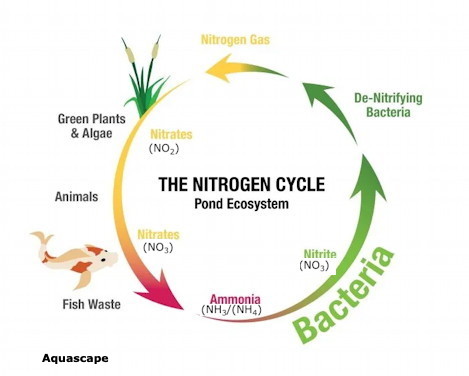
Ammonia is the main nitrogen waste from your fish and functions as the start of nature’s nitrogen cycle. Ammonia is excreted partly by the fish’s kidneys, but mostly by the gills.
As ammonia (NH3/(NH4) increases, Nitrosomonas bacteria, the biological filter, start to consume it and break it down into nitrite. Once nitrite(NO2) starts to accumulate, denitrifying bacteria breaks them down into nitrates(NO3).
Nitrifying bacteria seem to be present in all aquatic environments, including new aquarium setups. But in such tanks, there won’t be enough of them to process the waste produced by a full load of fish.
Nitrite-oxidizing bacteria (NOB) are microorganisms that oxidize nitrite to nitrate, a process known as nitrification or nitratation. Nitrates are then removed from the system by plants, algae, or water changes.
High ammonia levels indicate that there are not enough beneficial nitrogen-reducing bacteria living in the pond yet. These bacteria proliferate over time, so ammonia problems are most common during the first six to eight weeks of a pond’s break-in period. Later, ammonia levels can climb again if the filter gets clogged.
See Understanding the Pond Nitrogen Cycle: Why It’s Important to Your Fish | AquaScapeInc
and The Skeptical Fishkeeper: Nitrifying Bacteria | TropicalFish Magazine