Under Construction 
Contents: Personal Giving | Recipients: National Averages | Largest Charities | Evaluating Charities | Personal Experience | Solicitation Tips | Religious Stewardship | Educational
Personal Giving:
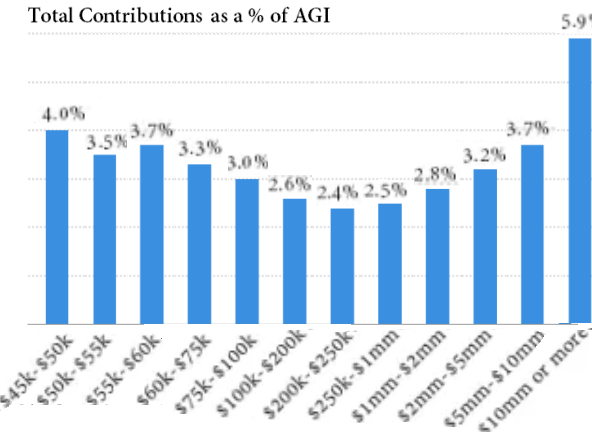 Source: The Average Percent Of Income Donated To Charity Can Improve
Top 10 Benefits of Charitable Giving and Donations
On average, high net worth donors gave $25,509 to charity in 2015.
By comparison, general population households gave $2,520 on average
2018 Charitable Giving Statistics, Trends & Data:
Source: The Average Percent Of Income Donated To Charity Can Improve

Top 10 Benefits of Charitable Giving and Donations

On average, high net worth donors gave $25,509 to charity in 2015.
 By comparison, general population households gave $2,520 on average

2018 Charitable Giving Statistics, Trends & Data:
 The Ultimate List of Online Giving Stats | Nonprofits Source
$128 dollars is the average online donation amount.
$326 dollars is the average annual donation total for recurring donors.

Greatest Gen:
88% of the Greatest gen gives to charity, donating an annual average of
 $1,367 across 6.2 organizations.

Baby Boomers:
71% volunteer locally, 9% internationally.
72% of Boomers give to charity, donating an annual average of
 $1,212 across 4.5 organizations.

______________
45% of donors enrolled in a monthly giving program.
The average monthly online donation is $52 ($624 per year)
 compared to the average one-time gift of $128.
An August/September Issue of AARP magazine reported tax return data from people tho itemized charitable gifts:
| Income | Giving |
| $50,000 - $100,000 | $3,140 |
| $100,000 - $200,000 | $3,910 |
| $299m999-$500,000 | $6,520 |
Religious Stewarship:
Close to two out of every three households (63%) donated some money to a church, synagogue or other place of religious worship during 2003. That percentage has remained constant since 2001, but is somewhat lower than the number of church donors identified in 2000 and in 1999 (66%).
From the above we see that total charitable giving from individuals was about $225M in 2006 and $100M or 44% goes to religious institutions.
When contributions are examined as a percentage of household income, giving to religious centers represents about 2.2% of gross income. 4% of the national population of households tithe (give 10%).
7-14% of born again Christians and 14% of evangelicals tithe.
Pollster George Barna writes, "Generally, the more money a person makes the less likely he is to tithe."
Source: barna.org
See Evaluating Charitable Organizations
Personal Experience:
In 2009 I participated in the Tubbs Romp to Stomp out Breast Cancer Snowshoe Series
220 participants in a snowshoe 3-5K walk/run raised $8,100 for an average of $37 per person.
I sent out email requests for donations to 24 people and got 6 responses (25%). These were fairly close friends.
I probably could have increased that with phone follow-up, but don't like twisting arms.
The most common donation was $25 with one $50 and one $100.
This was better than the 7% response I got for an American Cancer mailing to neighbors.
I sent out requests for donations to 75 people I knew in our church to support our team in a 5K run and 1 mile walk for the VA hospital.
I got 15 donations (20%) [ 8-$25, 5-$50, $200 and $250]
I got 7 out of 30 23% (most $20) for a 10K benefit.
In a phone-a-thon for my son's prep school I got over a 75% response when calling previous donors.
Solicitation Tips:
- Be direct in your subject line on e-mail.
The indirect subject line had a 21% open rate, but only a 4% response rate.
The direct subject line had an 18% open rate and an 18% response rate.
- Keep it short and simple
National Averages:
|
| Rnk | Organization | Giving
$M |
| 1 | Roman Catholic Church * | $33,000 |
| 2 | Southern Baptist Convention | $7,970 |
| 3 | LDS - Morman Church | $5,300 |
| 4 | United Methodist Church | $4,760 |
| 5 | United Way | $4,236 |
| 6 | Presbyterian Church (U.S.A.) | $2,920 |
| 7 | Evangelical Lutheran Church in America | $2,300 |
| 8 | Episcopal Church | $2,230 |
| 9 | Salvation Army | $1,998 |
| 10 | Lutheran Church-Missouri Synod | $1,200 |
| 11 | American Cancer Society | $1,039 |
| 12 | Food for the Poor | $1,017 |
* Catholic Church Giving is a very rough estimate.
|
| Rnk | Organization | Giving
$M |
| 13 | YMCA of the USA | $1,004 |
| 14 | Feed the Children | $933 |
| 15 | AmeriCares Foundation | $873 |
| 16 | Stanford U. | $832 |
| 17 | United Church of Christ | $824 |
| 18 | Catholic Charities USA | $801 |
| 19 | Gifts In Kind International | $750 |
| 20 | World Vision | $728 |
| 21 | Habitat for Humanity International | $702 |
| 22 | Boys & Girls Clubs of America | $697 |
| 23 | Feeding America | $645 |
| 24 | American National Red Cross | $643 |
| 25 | Harvard U. | $614 |
|
20 largest Charities - In terms of Annual Private Support (2008):
| Rank | Name | Private Support
$M annually | Net Assets ($mil) |  |  |  | Score
4
|
| 1 | United Way | 4,236 | NA | 92 | 86 | 100 | *a |
| 2 | Salvation Army | 1,998 | 10,853 | 92 | 82 | 39 | *b |
| 3 | American Cancer Society | 1,039 | 1,587 | 81 | 71 | 89 | 2 |
| 4 | Food for the Poor | 1,017 | 24 | 98 | 97 | 100 | 4 |
| 5 | YMCA of the USA | 1,004 | NA | 89 | 81 | 42 | *c 3 |
| 6 | Feed the Children | 933 | 554 | 92 | 84 | 57 | 3 |
| 7 | AmeriCares Foundation | 873 | 220 | 99 | 100 | 99 | 3 |
| 8 | Catholic Charities USA | 801 | 32 | 93 | 89 | 73 | 4 |
| 9 | Gifts In Kind International | 750 | 68 | 100 | 100 | 96 | 2 |
| 10 | World Vision | 728 | 151 | 88 | 86 | 102 | 3 |
| 11 | Habitat for Humanity International | 702 | 1,639 | 87 | 83 | 62 | *d 4 |
| 12 | Boys & Girls Clubs of America | 697 | 2,764 | 90 | 80 | 79 | 2 |
| 13 | Feeding America | 645 | 44 | 98 | 97 | 97 | 4 |
| 14 | American National Red Cross | 643 | 3,224 | 78 | 89 | 94 | 2 |
| 15 | St Jude Children's Research Hospital | 584 | 1,910 | 84 | 69 | 31 | 4 |
| 16 | American Heart Association | 533 | 815 | 83 | 77 | 81 | 3 |
| 17 | Goodwill Industries International | 490 | 2,948 | 96 | 88 | 68 | |
| 18 | Nature Conservancy | 486 | 4,715 | 87 | 80 | 4 | 4 |
| 19 | Campus Crusade for Christ | 470 | 108 | 93 | 87 | 97 | *b |
| 20 | MAP International | 393 | 169 | 99 | 99 | 81 | 4 |
| Other well known and/or highly rated organizations |
|---|
| Rank | Name | Private Support
$M annually | Net Assets ($mil) | | | | Score
4
|
| 21 | Boy Scouts of America | 377 | NA | 87 | 87 | 50 | *d 2 |
| 22 | Mayo Clinic | 367 | 4,309 | 91 | 97 | -69 | 2 |
| 24 | Compassion International | 311 | 94 | 91 | 83 | 96 | 4 |
| 31 | American Jewish Joint Distribution Committee | 242 | 380 | 99 | 93 | 88 | 4 |
| 34 | Susan G Komen for the Cure (breast cancer) | 234 | 128 | 93 | 83 | 84 | 4 |
| 36 | PATH | 226 | 685 | 100 | 86 | 39 | 4 |
| 40 | Public Broadcasting Service (PBS) | 220 | 365 | 99 | 97 | 54 | Av. 2.4
*e |
| 49 | Direct Relief International | 199 | 58 | 100 | 99 | 137 | 4 |
| 55 | World Wildlife Fund | 181 | 317 | 90 | 81 | 47 | 4 |
| 83 | Rotary Foundation of Rotary International | 133 | 738 | 93 | 85 | 24 | 4 |
| 86 | Children International | 129 | 38 | 89 | 81 | 96 | 3 |
| 87 | Conservation International Foundation | 129 | 220 | 96 | 84 | 54 | 4 |
| 90 | City of Hope | 127 | 747 | 81 | 84 | -3 | 4 |
| 105 | Humane Society of the United States | 107 | 207 | 88 | 84 | 93 | 4 |
| 106 | Heifer Project International | 104 | 116 | 84 | 76 | 77 | 3 |
| 136 | National Public Radio (NPR) | 75 | 428 | 96 | 82 | 15 | Av. 2.5
*e
|
| | National Christian Foundation | 460 | | 94 | | | 4 |
| | American Society for the Prevention of Cruelty to Animals | 60 | | 83 | | | 4 |
1 - Percent of private support remaining after fundraising expenses.
2 - Charitable services as percent of total expenses.
3 - Percent of private support remaining after surplus.
4 - CharityNavigator Score
*a. United Way is evaluated location by location - Some examples: Bergen Co. NJ -2; Somerset Co., NJ - 3; Capital Area Michigan - 2; Greater Twin Cities - 3; Denver - 3; Orange Co, CA - 3; Austin - 4, Berks Co., Reading, PA - 4; Baltimore - 2; Central Mass. Worcester - 1; Orlando - 3; Albuquerque, NM - 4; King Co, Seattle, WA - 4; Boston - 2; Atlanta - 3; San Antonio - 4; Philadelphia - 2; San Jose, CA - 1;
*b. CharityNavigator doesn't evaluate religious organizations because they are exempt under Internal Revenue Code from filing the Form 990. As a result, there is not sufficient data to evaluate their financial health.
See Religious Stewardship below.
*c. YMCA is evaluated nationally and location by location - Some examples: Orlando, FL - 2; Natl. Council, Chicago - 3; NY, NY - 3; Atlanta - 3; Los Angeles - 3, Houston -4
*d. Habitat for Humanity and the Boy Scouts are evaluated location by location and Nationally/Internationally.
*e. Public Broadcasting Service (PBS) and National Public Radio (NPR) are evaluated location by location. Most are given a score of 2 or 3 because of high marketing and administrative costs.
E.g. WHYY Philadelphia = 2 (Fundraising and Admin.= 38%); WGBH Boston = 3 (Fundraising and Admin = 26%); Minnesota Public Radio = 4
Examples:
Note: Some organizations like the Sierra Club are not included because a substantial portion of their revenue on is spent on lobbying, which makes them a 501(c)(4) . The Sierra Club Foundation which is the educational arm is a 501(c)(3) org.
Sources:
The 200 Largest U.S. Charities - Forbes.com
CharityNavigator.org
The 50 largest US charities ranked by total income at csmonitor.com
Evaluating Charitable Organizations:
You should consider how much of the money you donate goes to the causes they represent and how much is spend in fundrasing and administrative expenses.
Outside fundraisers can keep up to 90% of donations for their expenses.
Info at www.give.org - BBB Wise Giving Alliance - Gives Administrative and Fund Raising Expenses
Charity Navigator rates charities from 1 (poor) to 4 (exceptional) stars.
Ratings include Efficiency (Administrative and Fundraising expenses vs program expenses) and Capacity (sustained/grown programs and services over time, financial health)
- Information on their web site:
7 out of 10 charities evaluated spend at least 75% of their budget on the programs and services they exist to provide.
What To Do When A Charity Calls
Charitable Donations: Give or Take? at FTC.gov
Charity Governance: Don't Be Misled By Administrative And Fundraising Ratios--These Are Largely Irrelevant Numbers
The American Institute of Philanthropy (AIP) also rates non-profits.
Sierra Club NJ Chapter fundrasing:
General mailing: 1.5-1.7% resonse average donation $50
Previous (within 3-4 yrs.) donor mailings: 15-21% response - average donation $76
Note: Sierra Club giving in strong red states is much lower. I don't think they even bother sending out general mailings.
I've sent out letters to 14 neighbors for the American Heart Association and typically get 1 response with $25 about 3-4 weeks after the mailing. They set a goal of $60, I guess figuring I'll make up the difference; Nice trick.
The Presbyterian church I belong to gives over 20% of it's budget ($475,000 out of $2 Million annually) for mission projects, 80% of that to third world countries for direct aid, schools, feeding programs, healthcare, ....
Make-A-Wish:
Make-A-Wish raised $14 million last year from direct mail, but Make-A-Wish direct response manager Zachary Stahmer says Google is more effective. Direct mail gets a 2% to 3% response rate, he says, compared with 6% online.
Response Rates:
| Type of Donor | Response Rate Estimate |
| No previous association | < than 2%, most expect 1% or lower for good result |
| An association but no prior donation | 0.1 - 7%, mostly 2-4% |
| Donor but not in past 18 months | 2 - 20%. |
| Current regular donor | 5 - 90% |
Links:
10 Best Practices to Increase Email Response Rates for Fundraising
Other 501(c)(3) (tax exempt non-profits) organizations are required to file a form 990 with the IRS; Churches are not required to do this; as a consequence the data below are estimates.
2000-2002 Giving
| Church | US Members
(1,000) | Total $M | per capita |
| American Baptist Churches U.S.A. | 593 | $422 | $712 |
| National Baptist Convention, U.S.A. | 7,500 | ? |
| Southern Baptist Convention | 15,222 | $7,970 | $524 |
| Assemblies of God | 1,585 | $338 | $213 |
| Christian Church (Disciples of Christ) | 527 | $483 | $915 |
| Episcopal Church | 1,806 | $2,230 | $1,234 |
| Evangelical Lutheran Church in America | 3,811 | 2,300 | $603 |
| Lutheran Church-Missouri Synod | 1,908 | $1,200 | $631 |
| LDS (Morman) ‡ | 5,000 | $4,900 | $980
|
| Presbyterian Church in America | 247 | $484 | $1,957 |
| Presbyterian Church (U.S.A.) | 2,525 | $2,920 | $1,155 |
| Reformed Church in America | 177 | $264 | $1,488 |
| Roman Catholic Church | 64,000 | $33,000 | $524 |
| United Church of Christ | 1,377 | $824 | $598 |
| United Methodist Church | 8,340 | $4,760 | $571 |
| Average | $660‡ |
† Average per NCC's 2004 Yearbook
Giving includes congregational finances plus benevolence (10-15%) giving.
Source: Giving among Church Denominations at GenerousGiving.org
Their disclaimer: "This is a non-scientific table, not intended for republication or distribution to general audiences. It is designed only as a study aid for teachers and researchers for research purposes only. It is not authoritative and, therefore, its contents must not be cited in any published work."
Giving for Catholic, Morman (LDS) and some others comes from a variety of sources.
‡ Note: The Morman Church (Latter-day Saints - LDS) does not publish financial data, and these numbers come from other estimates.
A Time magazine article estimated US member giving was $4.9 B in 1997. With 5 million US members that works out to $980 per member. This seems low considering the high rate of tithing.
Giving per member is also a function of family size and the age at which children become members. We would expect Catholics and Morman numbers to be lower because of large family size.
According to adherents.com/:
Conservative Protestants give more than 3 percent of household income.
Mainline Protestants, 2 percent.
About 30 - 45 percent of Latter-day Saints (Mormans), tithe.
Per-capita giving in the Assemblies of God exceeds 5 percent.
Seventh-day Adventists give more than 4 percent of their income.
Jewish per-family giving rivals that of Latter-day Saints, but give more to secular Jewish federations than to synagogues.
See Also: News from the National Council of Churches
Cultivating an Individual Donor Base
Well-to-due Church Giving Example (1999)
1,000 members;
Around 290, half of the 580 giving units (roughly households), pledge.
|
Yearly church finance and benevolence giving
| Num1 | Cum %2 | Pledge | Cumul. |
| 19 | 3% | > $10,000 | $285K |
| 27 | 8% | $5,000-10,000K | $488K |
| 47 | 16% | $2,600-$5,000K | $666K |
| 31 | 21% | $2,080-$2,600K | $739K |
| 29 | 26% | $1,560-$2,080K | $791K |
| 54 | 36% | $1,040-$1,560K | $860K |
| 39 | 42% | $520-$1,040K | $890K |
| 44 | 50% | $1 - $520K | $900K |
| 290 | 100% | $0 | $900K |
1. Number of giving units out of a total of
580 from 1,000 members.
2. Cumulative % is of all giving units.
Only 1/2 of giving units pledged.
Average: $3,000/ pledge per giving unit
In 1997 giving was $1,080/member.
In 2002 giving was $1,360/member.
In 2008 the same church gave $1.8M or $1,518/member.
Note: Actual collections are typically 33-40% higher than pledges because of people who don't Pledge and plate receipts from guests.
This is in an upper class area of the county with the highest median income (>$83K) in the country, so only a fraction tithe (give 10%).
Studies also indicate that roughly 75 percent of money is given by 25 percent of the people across all denominations.
|
Capital campaign for a $4 M building program
3 year giving total pledges.
| Number | Cum | Amount | Cumul. |
| 1 | 0% | $400K | $400K |
| 2 | 1% | $250K | $900K |
| 4 | 2% | $150K | $1.5M |
| 5 | 4% | $100K | $2.0M |
| 12 | 7% | $50K | $2.6M |
| 15 | 12% | $30K | $3.0M |
| 19 | 18% | $12K | $3.3M |
| 25 | 25% | $10K | $3.5M |
| 39 | 37% | $6K | $3.8M |
| 50 | 53% | $3K | $3.9M |
| 55 | 69% | $1.5K | $4.0M |
| 100 | 100% | <$780 | $4.0M |
|
Educational Giving
Sources of Private Giving to Higher Education, 2006 and 2007
| Category | 2006 | Share of 2006 Total | 2007 | Share of 2007 Total | |
| Alumni | $8,400,000,000 | 30.0% | $8,270,000,000 | 27.8% | |
| Non-alumni individuals | $5,700,000,000 | 20.4% | $5,650,000,000 | 19.0% | |
| Corporations | $4,600,000,000 | 16.4% | $4,800,000,000 | 16.1% | |
| Foundations | $7,100,000,000 | 25.4% | $8,500,000,000 | 28.6% | |
| Religious organizations | $375,000,000 | 1.3% | $380,000,000 | 1.3% | |
| Other organizations | $1,825,000,000 | 6.5% | $2,150,000,000 | 7.2% | |
| Total | $28,000,000,000 | 100% | $29,750,000,000 | 100% |
Top 20 Colleges and Universities in Fund Raising, 2007
| Institution | Rank in 2007 | Rank in 2006 | Total Raised
in 2007
$M | 1-Year % Change |
| Stanford U. | 1 | 1 | $832 | -8.7% |
| Harvard U. | 2 | 2 | $614 | 3.2% |
| U. of Southern California | 3 | 6 | $470 | 15.7% |
| Johns Hopkins U. | 4 | 7 | $430 | 14.1% |
| Columbia U. | 5 | 8 | $424 | 12.3% |
| Cornell U. | 6 | 5 | $407 | 0.2% |
| U. of Pennsylvania | 7 | 4 | $392 | -4.2% |
| Yale U. | 8 | 3 | $391 | -9.7% |
| Duke U. | 9 | 9 | $372 | 12.1% |
| UCLA | 10 | 11 | $365 | 14.1% |
| MIT | 11 | 21 | $329 | 39.7% |
| U. of Chicago | 12 | 19 | $328 | 38.5% |
| U. of Wisconsin at Madison | 13 | 10 | $325 | -0.2% |
| U. of Washington | 14 | 12 | $300 | -5.1% |
| U. of Michigan | 15 | 16 | $293 | 16.7% |
| U. of Minnesota | 16 | 14 | $289 | 8.1% |
| New York U. | 17 | 13 | $288 | 2.7% |
| U. of Virginia | 18 | 22 | $283 | 30.6% |
| Indiana U. | 19 | 17 | $279 | 12.5% |
| U. of California at San Francisco | 20 | 26 | $252 | 25.2% |
| UNC | 21 |
| UC Berkeley | 22 |
| Princeton | 23 |
| Texas | 24 |
| Ohio State | 25 |
| Purdue | 26 |
| Notre Dame | 27 |
| Northwestern | 28 |
| Illinois | 29 |
| Cal Tech | 30 |
Source: Inside Higher ED and UNC Development Update 09-24-08.pdf
Rescue Squads:
Some states/communities have volunteer Rescue Squads which provide free ambulance service to hospitals funded by donations.
A local one here got a 37% household response rate with an average donation of $54.
Links:
Top 100 Nonprofit Organizations | Top Nonprofits
Charity Navigator: The Ten Best Charities in The U.S. Direct Relief
The 50 Largest U.S. Charities List - Forbes 2015
Donation Letter help at FundraiserHelp.com
Non-profits
Exploring physical activity events as fundraising tools in the nonprofit sector International Journal of Nonprofit and Voluntary Sector Marketing, Volume 8, Number 4, November 2003
Fundraising Market Study at Simon Fraser Univ. in Canada
http://www.smartgivers.org
The 200 Largest U.S. Charities - Forbes.com
The NonProfit Times - The Leading Business Publication For Nonprofit Management
Philanthropy
The Chronicle of Philanthropy: The Philanthropy 400
last updated 10 Mar 2019
|
